
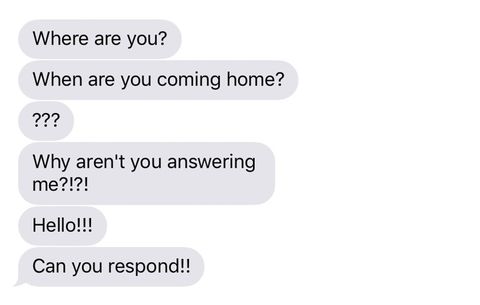
I’ve been hearing this a lot lately and I want to talk about it. I do not think I personally have trust issues but a lot of people struggle with it so I think it’s an important topic. How do you know if you have trust issues? Well here are some signs. You don’t believe anything anyone tells you and you jump to the worst possible situation as an explanation. There is a very thin line between healthy skepticism and having trust issues but in general; try to evaluate where your distrust is coming from. If it’s coming from the behavior of a person in your past then you need to work on separating what has happened with what is currently happening.
For example, let’s say a potential significant other that you have been interacting with for the past few weeks doesn’t respond to a message you sent them for three hours. When they finally do; they apologize and say they were working. Do you A) believe them or B) not believe them. If you chose B, why did you choose B? Is it because you had an ex say that for three weeks in a row and you found out later that he/she was cheating on you with their coworker? If you don’t believe the person currently in your life because of something that happened in your past without considering what you know about that person, then you might have trust issues.
But not believing something someone says does not necessarily mean that you have trust issues. I am in no way suggesting that you should blindly trust everyone. For example, if you chose B) do not believe, because two days ago they informed you that they’d lost their job; then you should definitely be skeptical of the excuse that they were working. But the point is that you evaluated their statement based on what you know about them, and that, my friends, is logic.
In general, I will pick A) believe them, because I don’t care enough about the promptness of their response to struggle with whether to trust them or not. But even if I did care; constant communication wouldn’t make me trust someone more or less. If he’s a two pump man, he could’ve cheated during the five minutes he didn’t respond. And if he didn’t respond for an hour, mathematically, he could’ve slept with 20 different women. And he’s responding every five minutes to keep you from guessing that he’s cheating. This thought process does nothing more than cause your head to spiral with worry and you have no reasonable way of verifying or disproving what he did within every five minutes. So my point is that no amount of communication or validation is going to help you with your trust issues; it just puts pressure on your partner to compensate for an issue you won’t deal with.
Now I know what you’re thinking: But I’ve been hurt in the past. They lied. They cheated. They stole. They took advantage. I get it. It’s happened to me too. It’s pretty much happened to everyone. You aren’t special because you got hurt. Everyone gets hurt at some point in their life and most people let it continue to negatively affect their current relationships for years after. You may think that putting up a wall protects you and keeps you from getting hurt but it’s doing way more harm than good. Not only does it fester and slowly chip at your positive view of the world, ultimately destroying your happiness but it also creates a self-fulfilling prophecy. Have you ever noticed how people who constantly talk about getting cheated on are always getting cheated on? Or what about the person that is always claiming to get abandoned? They seem to not have any real friends.
Think of the game I-spy that some of us played when we were kids. “I-spy something green.” Your mind automatically filters out everything in your eyesight that isn’t green. You focus only on the green objects; ignoring the colors of everything else to search for what you’re looking for and for a second, it feels like EVERYTHING IS GREEN! It’s the same thing with how we interpret human behavior. You will almost always see what you’re looking for. When you learn to trust, you won’t filter out the good and focus on the bad, you’ll see the whole beautiful picture and then you won’t see the bad as necessarily bad anymore just as part of the experience. It’s a long process, dedicating yourself to trusting and focusing on the here and now and evaluating the people in front of you based on their own merit instead of how someone else treated you, but I promise; it’s worth it.

 Closed System