
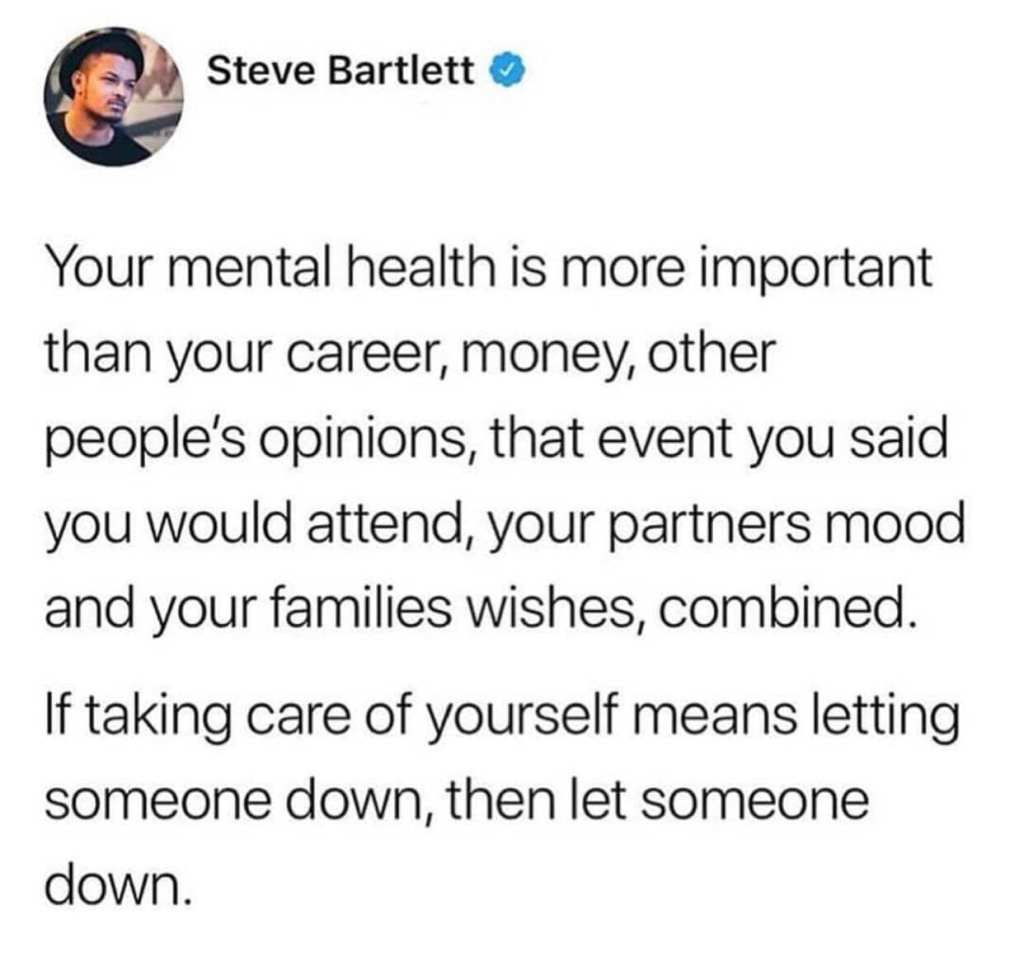
Once again my inspiration for writing a blog comes from a meme that has greatly irritated me due to it’s oversimplification of a complex topic.
The meme states that your mental health is more important than the combination of importance assigned to your career, money, other people’s opinions, events you said you would attend, your partners mood and your families wishes. And that if you need to let someone down to boost your mental health then you should do so without batting an eye.
The further implication of this meme is that mental health is more important than anything and everything else. Which I will argue against momentarily, but first I want to tackle what the meme is actually addressing.
What is mental health?
Definition: a person’s condition with regard to their psychological, emotional and social well-being. It affects how we think, feel and act. It also helps determine how we handle stress, relate to others and make healthy choices.
Mental Illness – there are over 300 mental disorders listed in the DSM-5. Which are grouped into Mood disorders (such as depression or bipolar disorder), anxiety disorders, personality disorders, psychotic disorders, eating disorders, trauma related disorders and substance abuse disorders.
Mental illness and mental health are often used interchangeably but they do not mean the same thing. Good mental health is not the absence of mental illnesses and bad mental health does not indicate the presence of a mental illness.
The sad truth is, if you have depression or other mental illnesses, it’s unlikely that they will ever go away. And it’s largely out of your control. The symptoms may or may not strike you at any moment without mercy. Or they may have an ongoing presence. This is something you’re going to have to accept. But even within your mental illness you can work to have good mental health. Good mental health doesn’t translate to being happy all of the time. And it’s not associated with vapid positivity either. So then, what exactly is good mental health?
Before I discuss the more professional descriptions, ask yourself, what is good mental health to me? What does it mean to me? Is that attainable? Write it down if you can so you can compare later.
Mental health, just like our brains, is complex. Having ‘good’ mental health is more of a culmination of your ability to cope with stress, to accomplish things, cultivate relationships, and realize your own potential. People who have good mental health, have strong resilience. They are confident in themselves that they will be able to face new situations and new people, they feel optimistic most of the time, they don’t place blame on themselves unrealistically, and they overall have a high self-esteem. For people with a mental illness, accomplishing good mental health will be harder but it’s not impossible. And you can have bad self esteem issues and struggle to feel optimistic without having a mental illness.
Now back to the meme. It implies that in our world it is always our mental health vs. everything else. Your mental health is more important than your career, your mental health is more important than your money, your mental health is more important then other people’s opinions or your friends, your mental health is more important then the events you said you’d attend, your mental health is more important than your partners mood or your romantic relationship, and your mental health is more important than what your family wants. And if you have to let someone down to take care of your mental health, then you should do it. But by definition, mental health encompasses and is affected by all of these things, therefore it makes no sense to say that mental health is more important than them. They are intertwined.
Having a job that you enjoy most of the time and gives you the freedom you want, contributes to your mental health. Having friends to support you when you need it contributes to your mental health. Having a significant other that you can be yourself around and who listens to you contributes to your mental health. But there is always a trade off. Sometimes your best friend calls you at midnight because something awful has happened and she needs you to talk to. You are sacrificing your sleep to be there for her. But overall, throughout the length of the relationship the sacrifices we make for people should be worth it. What we say yes to and what we say no to should be balanced to promote overall good mental health and maintain healthy relationships with the people we care about. But this is constantly being calibrated and reevaluated based on the relationships we are engaging in.
Often you need to take a step back and evaluate how someone is impacting your life from an overall perspective. This is difficult because we are often very biased when evaluating our own behavior in comparison to another person’s behavior. But with practice, experience and additional perspectives, we can learn to recognize relationships that deserve more effort vs. less effort.
This is why I disagree with the statement made in the meme. There is nothing wrong with making sacrifices for the people that you love and care about, but always ask yourself if they would do something equally as difficult for you or if they are deserving of your efforts.
If I promised a friend I’d go to their birthday party and I’m in a grouchy mood, I will weigh letting down and missing out on a party I want to go to and may feel regret after when the pictures are posted and I wasn’t there to laugh at the jokes and create another memory. Sometimes I choose not to go. Sometimes I force myself to go and clear my schedule for the day after so I have some time to unwind.
I remember when I saw Luke Combs live, it was years ago at a super small venue in Fort Worth before he got big so the tickets had been really cheap. I was maximum irritated and grouchy and fed up with the human race that day but I forced myself to go because of how badly I wanted to see him live and I knew it would probably be my only chance to do so. And I was right.
There are countless examples where I sacrificed my mental stability in the moment to gain something else long term. and I don’t regret it. And there are also countless examples where I backed out of something for my mental stability in the moment and I didn’t regret that either. I honestly believe that this simply takes practice, experience and self awareness to perfect. If you are paying attention, to why and when you make the decisions you do, you’ll be able to create lasting good mental health for yourself.
What are you doing too much of right now? Do you compromise your mental health frequently to sustain relationships? Or do you find yourself so consumed with controlling your mental health that you lose friends frequently?

 Closed System