One Year Later, I Still Miss You.

One year ago today, my Mom died.

Grief is such an odd thing to process. A year later, I try to assess how I’m doing. But the criteria for doing so, is so subjective. Do I seem to be functioning as an adult? Mostly. Not too much different than before she died. But do I still break down because I can’t call her up and just talk to her? Yes. I try to think of friends I can trust like I did her, and everyone comes up short. Not to slight my friends, I have a lot that love me and care about me. But in comparison to how a mother loves their child, everyone else loves you under conditions. Everyone else judges you. And no one is trustworthy.

When I’m down, I try to think about what she would tell me.

“I don’t care what you did, you’re better.”

It wasn’t like I thought she was always right. Normally, I’d roll my eyes at her dismissal of my mistakes. But there was a part of me that after hearing that my mom still loved me, despite something that I did or said, helped me breathe a sigh of relief. And I’d think, did I screw up? Yes. Does my mom still love me? Yes. Alright then, fix the mistake or learn from it and now you’re good. Such a simple reminder from my mother and I’d kick myself out of my pity party and take care of business.

Now it takes longer. And it’s lonelier.

And I can’t talk about how she died because it makes people uncomfortable. There’s never a right time to bring up how your mom was murdered in new friendships. So I just don’t bring it up or I awkwardly blurt it out. And then I get mad because how she died is more interesting than who she was.

And the worst part is that the court case hasn’t even happened yet. I was recently subpoenaed which means I might give a testimony. So I find myself stuck in this limbo trying to figure out how much I’m allowed to continue to be sad about it, how much I’m still allowed to miss her or be upset about her last moments, and how much I want to remember her when she was actually herself and not talk about my mom after he changed her. I hold out for the trial to bring some closure so I feel like I need to hold on to that pain and anger until that date when she hopefully gets the justice that she deserves. But then I’m afraid that after the trial, I’ll just forget about her. I’ll lose the sadness and the reasons why I miss her. So I hope the trial never comes, and I can hold on to my grief and postpone closure. I don’t want her to be forgotten.

And while I wait, I work to appear normal and not vulnerable, because I don’t want the most interesting thing about me to be that my mom was killed. I don’t want her death to define me. I want her life, and how she loved and smiled and danced and sang to be what lives on through me.

A year later, and I still don’t know if I’m ‘handling it well.’ All I know is that I still miss her.

The New Normal

Lisa Sutton continued making brush strokes on her recent painting in progress. It was of a man sitting outside of the back of his van selling dog-like muzzles for humans. Months ago, this man would have been selling watermelons or maybe even tomatoes but now he was selling muzzles meant to prevent humans from biting one another.  She stared at the half finished painting, fussing over forgotten details and cursing herself for not taking a picture when she’d had the chance. 

Lisa heard a knock at the door to her studio and yelled for the person to come in assuming it was her boyfriend, Randy. The door creaked open and her boyfriend walked in with a smile on his face and still dressed in his electrician’s uniform. “Hello my artistic girlfriend.” He said crossing the room and kissing her gently on top of her head. She turned to him. “Hey babe, how was work?” She asked. “Fortunately, I’m staying busy. Whether it’s the end of the world or not, turns out people want electricity right up to the last day. What are you working on?” He asked. “Oh just something that captures everyday life for people now.” She said, turning back to the painting with a critical eye. Randy straightened his back and put his arms straight out in front of him with his hands vertical; making fun of the new sign language that told people at a distance what you were, and then he shouted dramatically, “The new normal!”

“Ugh, do you have to say that in here? I’m going to lose it if I have to hear that phrase for the rest of my life.” Lisa said. Randy laughed. “Have you gotten your tests confirming your diagnosis yet?” He asked. Lisa shook her head. “I haven’t and it’s really upsetting me. It’s been almost three weeks since I was bitten and I still haven’t heard anything. Meanwhile, my mother is begging me to visit her in Egypt before things get worse.” She said.

Randy pulled up a chair next to her so he could talk more comfortably. “It’s really a shame that you were bitten, if people simply wore their muzzles in public like they were supposed to then this zombie virus wouldn’t have spread so much.” He said, gently stroking her shoulder. Which had already turned a dark grey, and as soon as Randy touched it; promptly fell off. Randy stared at the small piece of flesh on the cement floor. And then glanced back quickly at Lisa like he’d been caught stealing a cookie from the cookie jar. But she was throwing her head into her hands and hadn’t noticed that a piece of her shoulder was missing. “I wish you wouldn’t call it that. Zombie virus. It makes me feel like we are living horror movie.” She said through muffled tears. “Umm… my love… um…” Randy said, pointing down at the floor. Lisa turned and looked but her eyes did not widen as Randy’s had. She simply bent down and picked up the flesh. “Yeah, this started a couple days ago.” She said, and then gently pushed the flesh back into her shoulder. “Have you begun to show any symptoms?” Lisa asked. Randy leaned back. “Um well. I’ve lost taste for everything except red meat but I’m still able to eat it cooked.” He said. Lisa burst into tears. “I’m.. so ….sorry I gave this to you. I..I…” She stammered. Randy shook his head. “It’s okay, Lisa, we are young. We will be fine. We can survive as zombies as long as we wear our muzzles when we go out and stay away from our grandparents and my parents until they find a cure.” Randy said in as comforting a tone as possible. The problem was that he wasn’t so sure that he believed his own words. America had not done a good job containing the virus and they were currently being quarantined without any end in sight. He put his arms around her and pulled his decaying girlfriend in for a hug.

How to Argue on Facebook: Part 1

Instead of posting my stance on topics of the day, it has come to my attention that the general American public is awful at arguing, debating and recognizing their own biases and logical fallacies. So this is going to be a quick study guide on how to argue on Facebook. For this post, I will concentrate on natural biases that we all harbor. Regardless of your level of intelligence, everyone struggles to overcome these biases but if you are aware of them, you can diminish their effects in discussions with your friends and enemies on Facebook.

First, what is a cognitive bias?

A cognitive bias is defined as a systematic error in thinking that occurs when people are processing and interpreting information in the world around them and it affects the decisions and judgments that they make.

There are dozens of known biases and I will provide links below that list them but basically biases come from our brains’ desire to efficiently make shortcuts in decision making. This causes us to make faulty assumptions and arguments based on unreliable information and a warped view of the world. Most of the time, biases don’t cause much harm and they may have many benefits in keeping us alive but they can also discredit it us and cause us to be stuck in toxic worldview. Below I’ve outlined only a couple of common biases, if you find yourself hanging your head in shame at recognition that you do these some or all of the time. Don’t feel bad. I do too. And so does everyone. It takes practice to recognize when others are using them and even more self awareness to recognize when you are stuck in a cognitive bias box.

Confirmation bias

Also metaphorically referred to as the echo chamber. This bias revolves around our brains desire to hold onto the truths it already believes. The result of this desire is an individual seeks out information that agrees with how they already think. They read articles and data that agrees with them and avoids information that disagrees with them. You might surround yourself with friends that agree with you and simply block and ignore people who disagree with you or represent the opposite viewpoint as your own. Social media is often accused of reinforcing confirmation bias. Due the ease with which you can control the information you see and the algorithms used to show you things you will already agree with. And even if you are aware that confirmation bias is an intimate part of how you think, it can be difficult to combat. Neil DeGrasse Tyson, a famous astrophysicist stated in his masterclass that he often reads books about topics that are in direct opposition to his current worldview. He stated that he reads books on astrology and aliens to make sure that he not only understands how others think but that he is continually challenging his confirmation bias. The trick however is that it isn’t enough to simply read things that you assume you might disagree with it; you must read and listen with an open mind. You must almost hope that what you’re reading will change your mind and work to let it. And if you really want to combat your confirmation bias, take on the arguments of the worldview in opposition to you and argue in their favor in a constructive way. If you can truly think from the opposite perspective of your own, you will see the glaring holes in your own arguements and either adjust how you think or you will patch those holes up. Essentially, you will not know that your foundation is strong until you challenge it. It can be painful at first but the goal here is to have the most accurate way of viewing the world as possible and not to be someone who is stuck in their ways. 

https://en.wikipedia.org/wiki/Confirmation_bias

Polarization Effect

Associated with confirmation bias is the polarization effect on opinion. This effect is what occurs as a byproduct to confirmation bias. When given information that is opposed to your current worldview, your natural tendency is to reject the information and reinforce your current held opinion. Studies have shown that if your opinion is actively stated or written, then you become more stubborn in solidifying your worldview due to the open commitment (maybe this is why we still get married and announce relationships publicly but that is a different topic). Announcing your opinion can then increase the problem of the polarization effect. This is an attempt to battle confirmation bias gone wrong. It occurs because the subject is only listening out of obligation to prove that they are still right and not with an open mind genuinly seeking to learn. If information, opinions or data are not considered from an unbiased perspective, you will only deepen your resolve. If the other person also exhibits the polarization effect, they will only deepen their resolve. And now you have two parties that believe in their viewpoint beyond what is reasonable. On a small scale, this tendency isn’t such a bad thing. But these polarizations and confirmation biases can have widespread affects on policy and cause mass genocides. Why did the nazi extermination of the jews happen? Confirmation bias and polarization of opinion. Why were millions of African Americans enslaved, requiring a civil war that killed hundreds of thousands of people to end that slavery? Confirmation bias and polarization of opinion. If you hear someone else’s point of view and it doesnt cause you to question yours even a little but rather causes you to cross your arms and proclaim that now you believe even harder! Then guess what, you are a part of the problem.

https://en.wikipedia.org/wiki/Group_polarization#Attitude_polarization

The Dunning Kruger Effect

Basically stated, it suggests that the more you know the less confident you are while the less you know, the more confident you are. It sounds rather simple but this is an actual studied effect that is a part of human psychology. On topics of controversy, it is often the experts or people who are well versed in the topic that stay silent or regularly admit to not knowing everything. While people with little to no knowledge or direct experience seem to go on for ages about their opinion that has excessively oversimplified a complex issue.

For example

Man: Why dont women who were raped just take Plan B if they dont want the baby?

White person: why dont black people just not commit crimes and then the cops wont be mean to them?

These oversimplified opinions are not unique or ground breaking they merely reveal your complete and utter lack of ability to think about a perspective outside of your own. No everyone is not entitled to their opinion. Especially if that opinion is the first ill informed thing that vomited out of your mouth.

The question to ask yourself before you go into a topic is to ask yourself what about my experience gives me a credible opinion on this matter? If I argue for rights for immigrants is it because I’ve read books and books on how immigration impacts a country, have I talked to hundreds of immigrants and asked what they wanted or needed or why they emigrated in the first place? Or am I talking from a place of fear because of a single article I read online while living hundreds of miles away from densely populated cities with immigrants? If you only know one person that has immigrated to the United States and argue in favor of her experience, guess what you dont have enough information either. The trick is to enter debates seeking to understand and gain information coming from a place of where you constantly acknowle that it is likely that you do not know enough yet. 

For my dancers out there, this effect also translates to abilities and skills. If you’ve ever asked someone to dance and they responded with, “Do you even know how to dance?” and you kind if pause, thinking well, there are definitely people better then me. I have a lot to learn so it’s possible she/he is better than me. After considering this you answer “I’m alright.” and she/he begrudgingly agrees to dance with you and proceeds to be the one of the worst dancers you’ve ever danced with, then you are dancing with someone who has fallen under the Danning-Kruger Effect.

The general way to overcome this is to realize that your ability or knowledge on a topic is almost always lower than what you think it is.

https://en.wikipedia.org/wiki/Dunning%E2%80%93Kruger_effect#:~:text=In%20the%20field%20of%20psychology,recognize%20their%20lack%20of%20ability.

The Fundamental Attribution Error

This error is the tendency to believe that what people do reflects their character or who they are while what you do is merely a reflection of the circumstances or the situation imposed on you. A very classic explanation of this is when someone cuts you off in traffic, your immediate thought is that they are a jerk or a bad driver but when you cut someone off, you excuse it because you are late to work or you had to make your exit or your wife is giving birth and you’re going to miss it. In this instance, the Error is mostly harmless, however, it can have overarching effects on our judgments of others. If you believe cop violence is enacted only on bad people who have committed crime but if you were in a similar situation facing the cops and being mistreated you wouldn’t attribute their mistreatment due to your crime or perceived crime, you would postulate that the cops were corrupt. Or you might even dismiss your crime as necessary for survival. If you believe the cops’ actions were due to them having a mental illness or being a bad person but then you as a cop, dismiss mistakes and situations that were overly charged emotionally and that you are tired and haven’t been trained correctly then you are falling under the spell of the fundamental attribution error. 

Or if you see someone being abused by their husbands and you state that they must just be weak or lazy to not leave. 

If you see a man abusing his wife, you might simply state that he is a bad person and that is why he is hitting her. 

In this way, complex social issues are often pinned on a single individual and ignored instead of dealt with on a larger scale.

https://www.simplypsychology.org/fundamental-attribution.html

Myself

A conversation with the part I don’t like:

“They just extended the stay at home order another month, I don’t know if I can be alone with you another month.”

“Wow you must really hate yourself.”

“I don’t hate myself. I hate you.”

“Um.. I am you. I’m literally in your mind.”

‘You’re not the real me. You’re the devil, the bad part or the negative part. I don’t know. The real me is happy, encouraging, uplifting and creative.”

“If that were true, why do I always take over when you’re alone? Why are you so afraid of yourself?”

“I’m not afraid of me. I’m afraid of you. I can’t control you. You do what you want. You say what you want. You think what you want. You feel what you want. And you’re selfish. You scare all of my friends away and then I’m left feeling lonely.”

“I do not scare them away. You do. You are the one that ruins everything by trying to be exactly what they want.”

“That doesn’t make any sense.”

“They see you hiding me. They see you fighting hard to keep me suppressed. YOU don’t like you, so they don’t respect you. You’re so afraid of me ruining things that you ruin them before I even get the chance to.”

“That’s because if I ruin them first, then at least I stay in control.”

“You control nothing. What happens when you put a lid on boiling water?”

“It boils more.”

“That’s right. You’re trying to put a lid on yourself so people don’t see that you’re boiling. But they see it. They see the water boiling out and onto the stove, sizzling loudly and causing a mess. So they back away. If you would just take off the lid, let go of your control, let go of trying to hide me and your fear of me, I’d be able to help you.”

“This metaphor is stupid, I’m just supposed to let you boil?! What good will that do?”

“Boiled water is clean. Boiled water is safe and useful.”

“That’s great and all but I’ve been fighting you for so long, I don’t think I know how to be myself anymore.”

“Might as well try. Everyone sees through your mask anyways.”

Accepting Your Negative Thoughts

First off what exactly is negative thinking? Thinking about bad outcomes or the awful state that things are currently in? The truth is, negative thinking is actually necessary and shouldn’t be rid of completely.

There are two types of negative thinking, the type that is negative but realistic and the type that is negative and not realistic. If it’s an unrealistic thought, it should be disregarded, but if it’s realistic, it should be considered further because realistic negative thinking can save your life. While unrealistic negative thinking will cause you to sink into stress, anxiety and depression.

On the flip side, the same can be said for realistic positive thinking and unrealistic positive thinking. Many people think that in order to combat unrealistic negative thinking, they have to overwhelm the unrealistic negative thoughts with unrealistic positive thoughts. This will never have the desired effect. All it does is cause the gap between unrealistic extremes to increase. And then your mind will have nothing to grab onto because it knows neither are true. All that is left is a hallow emptiness and a mask trying to be something that you’re not.

For a dancing metaphor, think about it like this. We are told not to step outside of our body center/weight. Why is this? When you step outside of your body with your left foot; you might try to step way out with your right foot to compensate. But experienced and new dancers can attest that this overcompensation actually causes an awkward off balance weeble wobble. If you continue to step outside of your body center/weight; you will eventually fall down. This isn’t a bad thing as a dancer. It’s something new people do because it is our instinct to match the extra energy the left foot attempted with the right foot, thinking this will balance us back out.

But even the most experienced dancers still occasionally accidentally step outside of their body weight, they just deal with it differently. Let’s say your left foot goes way outside of your body weight/center and you have that ‘Oh shit’ moment where your eyes widen because you realize you are now off balance. Don’t panic. It’s okay that you did that. It’s not the end of the world and it doesn’t make you a bad dancer. Instead of taking a huge step with your right foot outside of your body weight again, place your right foot directly under your body. You might wobble a little but if you place the left foot under your body right after; you’ve just regained your balance.

If the left foot is negative thinking and the right foot is positive thinking in this example then its easy to see how sometimes less is more. Less effort that is concentrated has a bigger impact.

It is important to remember that just because you HAVE a thought, that doesn’t make it TRUE. And it doesn’t make you a bad negative person. What matters is how you handle them.

For example,

Let’s say you have a really negative thought.

Everyone I love is going to die from this virus.

And you start to panic and stress because you’re thinking negatively and you told yourself to stop being negative so you jump to the other side and think something super positive.

No one is going to die. This is in God’s hands and we are all going to be fine no matter what we do. Everything is great.

You still might find yourself feeling stressed out. Why is that? Because your heart knows that neither one of these is realistic. And you are out of balance jumping dramatically from one side to the other and attempting to rationalize them both. Your thoughts will feel out of your control.

Instead when you have this type of thought:

Everyone I love is going to die from this virus.

And you start to panic, ask yourself is this realistic? If you aren’t sure logically, do some research. If you know in your heart that it probably isn’t; then correct it with a REALISTICALLY positive thought.

Statistically, most people will survive the virus.

Then bounce back to a realistically negative thought.

Some people will die though. Some people have died.

Then try another positive thought. Maybe one that is in your control and proactive.

But more people will survive if we all do our best to prevent the spread of the virus and stay inside. I can spend this time strengthening my relationship with God.

The problem with attempting to have just positive thoughts is that when your mind strays and has a drastically negative thought you then turn that on yourself, attacking your self-esteem for not being able to think positively ALL OF THE TIME. You can’t beat yourself into thinking positively. If you try it will only come back stronger and with a rebellious vengeance. Let yourself think negatively. Challenge your negativity. Oh yeah, is that the worst you got Mr. Negative. Because now you’re just being silly trying to come up with the worst thing ever that is never going to happen. I want you to stick around to help me, but you’re going to have to make sense.

Ok maybe that’s a little crazy. But the point is that thinking negatively doesn’t make you a bad person. Thinking negatively is there to keep us careful.  Your only responsibility is to evaluate which thoughts are realistic, which ones have merit. Which ones should be used to build your mind base. If your mind base is built off crazy unrealistically positive and negative thoughts you will fall down. And you can’t just think positively, just like you can’t dance only on the right leg. That isn’t dancing, that’s hopping, you will definitely fall down or get really tired. Especially if you’re dancing alone, you wont always have a partner to cling to when you feel out of balance.

I’ve gone through a lot in my life and I’ve developed a way to deal with things.

Most recently when my mom died, and I would talk about the circumstances surrounding her death, I was often shut down and told to THINK POSITIVELY. But attempting to force me to think positively would have removed me from the reality of the situation. And the situation was very negative. So basically they were asking me to just ignore the situation and just ignore the fact that my mom had been killed. I need both sides of realistic thought, positive and negative.

We are in a negative situation right now. And realistically, a lot of negative things are going to happen. Forcing yourself to THINK POSITIVELY will not help you. It will only cause the ground underneath you to turn to sand. Grab onto the positive and negative things that are realistic. The things that you can control and use those to build the base of your mind and heart. Let the unrealistic things float by you and don’t let them take root. When you get really advanced at this, you’ll be able to laugh at them as they pass you by. BOTH the unrealistically negative AND the unrealistically positive. In fact, you shouldn’t be thinking about your thoughts as being negative or positive, you should only be thinking about them as realistic or unrealistic.

This will be really hard at first. At first you’ll cry at every negative thought. You’ll beat yourself up because you can’t control your thoughts. And you’ll have to fight the urge to jump to the other side and be crazy positive so that you feel better. But remember that that crazy leap doesn’t make you feel better, it only causes you to feel more lost. BUT IT’S OKAY! It’s okay that you’re negative! It’s not a bad thing to be negative! Be negative. Let your negative flag fly. When you consciously choose the thoughts you want to be your mind base, every thought that doesn’t belong there becomes laughable or becomes an opportunity for exploration. You can’t choose the thoughts you have. You can only choose which thoughts take root. Let the realistic ones take root.

If you’re unsure whether something is unrealistic or not, REACH OUT! Don’t evaluate whether it’s bad or good and if it’s bad decide not to mention it. If something is super negative and stressing you out, figure out if it’s realistic. I don’t care how bad it is. Because a lot of the most beautiful things we have today are the products of negative thinking. The only reason depression and suicide is going to skyrocket during this virus is because of the vapid positivism you’re shoving down everyone’s throat to compensate for your own negativity that you’re ashamed of.  

And to start out, I’ll admit something negative that I’ve worried about and processed.

I’m scared that with so much distance, my friends will forget about me and I’ll lose them.

But I let that thought go because I know that realistically most of my friendships have a solid base.

I might lose a friend or two. But that is just a part of life. Friends come and go, that doesn’t make them any less valuable.

All I can do is continue to offer and show my friendship to the best of my ability at a distance until all of this over.

Prove Me Wrong

I’m wondering what the death toll has to get to for people to start caring. 100? 1000? 100,000?

How close to home does it have to be for you to care?

When it killed the Chinese, no one batted an eye. While it’s killing the Italians, we don’t care. When it’s just a few Americans in Washington state, we aren’t concerned. When it’s next door to you, will you start to worry? When it’s your grandmother, will you write it off because it’s only killing the elderly?

One of my favorite people on this planet is older than 80 and my friends that repeatedly say it’s just the elderly tell her over and over again that she doesn’t matter, when she’s five times the person that you could ever hope to be.

But the truth is, this doesn’t just threaten people over 80, It threatens people in their 40s with asthma that have 10 year olds to raise. The elderly and people with respiratory issues are just more threatened.

You as a healthy 25 year old, can get sick and your immune system could fail you.

And if you keep saying that a 3% death rate is low, then you have a very poor understanding of percentages. 3% is one out of every 30 people. One out of every 30 people will die just because they shook hands with someone already infected or got coughed on. That is statistically, one person in every family.

When Red River allowed 500 people to dance on Saturday, if one of those people was infected, they just killed statistically 17 people. And the reason only 17 of those people will die is under the assumption that the other people that would survive under care would get care. If this allowed to get out of control many more than 17 will die because our hospitals simply don’t have the capacity to take care of the others.

Maybe this is just a conspiracy and we find out in the future. We can deal with that and be angry about that in the future when we are all still alive.

Maybe the media is causing hysteria, and if that’s true we can deal with that later too, when we are certain this virus isn’t as bad as we think it is right now.

Maybe it’s barely worse than the flu or equal to the flu. But the thing is, when the flu first started to emerge in modern society, it decimated us. The flu is actually pretty bad. Virus’ don’t have a cure once you get them, you just have to treat symptoms.

In two months I want to be bowing to everyone saying that we overreacted because the death toll stayed low. I want time to pass and us to realize this virus was nothing. I want to be really wrong here. I want to laugh at red river with all of my friends young, old, healthy or immune compromised to be teasing me that I freaked out for no reason. I want the morgues and the cemeteries to stay empty. I want everyone to be around so we can clean up the economy after. Because that can be repaired but once loved ones are lost, there’s nothing we can do. We wont be able to go to funerals together or console each other.

They will just be lost forever.

And we will have to continue to hide alone.

Please prove me wrong. Fight your desire to be rebellious and the fear you feel about being alone so that we can be together later.

I am not in the media, I am not part of any conspiracy, and I’m not saying that those aren’t possible but the risk that this virus is real and deadly is there too. If you aren’t considering that the virus is real and could not only kill you and someone you love, then you are setting up our country for a heartbreak as bad or worse then Italy.

Please, prove me wrong. I’d rather be wrong and us be alive together later.

https://www.worldometers.info/coronavirus/country/us/

https://www.worldometers.info/coronavirus/country/italy/.

Accepting Yourself isn’t the Opposite of Growth

Accepting yourself isn’t the opposite of growth. They are some of the steps to progress.

  1. Find the Weakness

The first step is to figure out what your weakness is or what you might be doing wrong. This part is hard because our ego spends years convincing our conscious selves that there isn’t anything wrong. It creates a blind spot in understanding ourselves and our behavior to protect us. You have to do some intense self reflection and be open to input from people that you trust to find the areas in yourself that you can improve on. If you’re constantly asking yourself the same question or observing the same results of your efforts, you need a new perspective and to break free of your personal biases. But it doesn’t matter as much how you find the areas of improvement, as long as you do and you can confirm that they are in fact weaknesses.

2. Accept Yourself

The next step, once you’ve find those weaknesses or mistakes, is to accept yourself and love yourself in spite of your shortcomings. Remember you’re a work in progress. And this newly found mistake developed in response to your strengths.

For example, if you constantly chase new situations and stimulus, it’s probably because you didn’t have a stable life growing up. You didn’t have stability so you convinced yourself that you didn’t need it and became too adaptable in adulthood.

If your feelings have been dismissed your entire life, you become overly logical and deny the value of your own feelings. If you’re on the extreme side, you might even deny that you have feelings.

These weaknesses subconsciously develop in response to our coping mechanisms. And it takes a lot of effort to recognize our blind spots because our ego is working overtime to lie to us.

But even though the overly logical person will deny their emotions and the person running from thing to thing, person to person denies the desire for stability, it is actually what they want. Once you recognize your own weaknesses, and then you accept yourself as being a logical person that wants to be able to express their emotions, you will realize that the suppression of secret desires actually hinders your strengths. Once this is realized, your strength will be set free.

Your blind spot is like an exhausted tired 3 year old nagging you in the back of your mind. But if you push that three year old away, their cries only get louder. Once you pick up that three year old, and soothe it accepting that there is a part of you that is still very childish and needs a bit of coddling, that part of you stops crying for attention and you’re able to focus on the immense strength inside of you.

3. Growth

Once you accept yourself for the recognized weakness, the growth starts to happen naturally. You start to recognize where weakness is holding you back and you just tear it down or coddle it in the way that it wants, and literally over night, you can start to become the person you want to be.

If you can’t recognize your weakness and accept yourself not only in spite of it but because of it, you will not be able to grow. It will feel like you’re climbing up a mountain while God is throwing rocks at you for you to dodge.

For example, if you’ve recognized that your denial of the need for stability is a weakness and you’ve accepted yourself because you realize that the lack of stability made you a creative free spirited person, you will start to see where the unconscious desire for stability is controlling you. You might let toxic people stay in your life because despite their toxicity, they provide a consistent connection. Or you might rush relationships to a point of stability without having put in the work. If you accept that you have unconscious desires, you can now make them conscious and control them instead of fighting them.

If you are reading this and you feel like there is blind spot in your personality that’s holding you back, private message me. I’m developing something that will help people in the future recognize their deepest weaknesses. And I would love to have an open honest conversation with anyone willing.

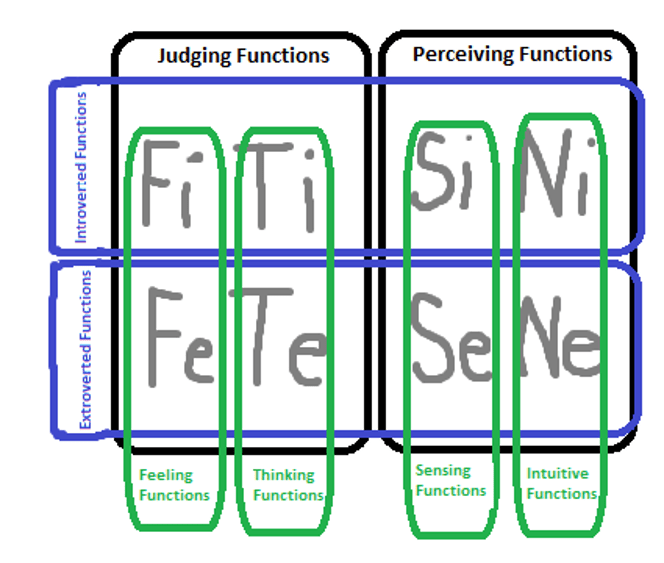
How are the Cognitive Functions organized?

The eight functions are listed below. I will describe them in greater detail on the next article. This article is just so that you can get familiar with how they are organized.

  • Introverted Thinking (Ti)
  • Introverted Feeling (Fi)
  • Introverted Sensing (Si)
  • Introverted Intuition (Ni)
  • Extroverted Thinking (Te)
  • Extroverted Feeling (Fe)
  • Extroverted Sensing (Se)
  • Extroverted Intuition (Ne)
 Judging FunctionsPerceiving Functions
IntrovertedTi FiSi Ni
ExtrovertedTe FeSe Ne

Introverted Functions –  Four of the functions are introverted. They are directed inwards, internal, rarely exposed to the outside world and will be filtered by the person’s extroverted function causing the actual introverted function to often be misunderstood. Introverted functions are developed internally by looking inwardly in the way that the function requires.

  • Introverted Thinking (Ti)
  • Introverted Feeling (Fi)
  • Introverted Sensing (Si)
  • Introverted Intuition (Ni)

Extroverted Functions – Four of the functions are extroverted. They are directed outwards, external, how we interact with the outside world, and are developed by interacting with the outside world in the way that the function requires.

  • Extroverted Thinking (Te)
  • Extroverted Feeling (Fe)
  • Extroverted Sensing (Se)
  • Extroverted Intuition (Ne)

Perceiving Functions – Four of the functions are perceiving, and they gather information that is either physical stimuli or abstract concepts.

  • Introverted Sensing (Si)
  • Extroverted Sensing (Se)
  • Introverted Intuition (Ni)
  • Extroverted Intuition (Ne)

Judging Functions – Four of the functions are judging, and they organize information, either rationally or emotionally.

  • Extroverted Thinking (Te)
  • Introverted Thinking (Ti)
  • Introverted Feeling (Fi)
  • Extroverted Feeling (Fe)

Breaking them down even further:

Thinking Functions – logically and rationally organizes external world or internal thoughts

  • Introverted Thinking (Ti)
  • Extroverted Thinking (Te)

Feeling Functions – emotionally organizes external or internal feelings

  • Introverted Feeling (Fi)
  • Extroverted Feeling (Fe)

Sensing Functions – concerned with real world physical information, whether concrete experiences from the past or current real time experiences,

  • Introverted Sensing (Si)
  • Extroverted Sensing (Se)

Intuitive Functions – concerned with abstract information, may focus on current patterns and how they will affect the future

  • Introverted Intuition (Ni)
  • Extroverted Intuition (Ne)

So we add the final dimension:

Don’t You Usually

The empty socket in my mouth where my tooth had been pulled ached. I needed to get home, lay in bed and watch some entertaining but not mentally strenuous television.

As I stuck the key into my ignition, I sighed. I remembered my roommate chasing me down the hall last night as soon as I’d gotten home from having my tooth pulled. “Will you have rent by Friday?” He mumbled. “Whaht?” I asked, gargling the extra spit and blood in my mouth around the gauze. “Rent. Will you have it by Friday?” He asked again.

At first, I wanted to tell him to just message me these things instead of chasing me down the hallway like my hair was on fire but I didn’t feel like prolonging the conversation, so I rolled my eyes and said. “Yeah. I’ll have it tomorrow.” And turned away. I shouldn’t be so hard on him. He has diagnosed Asperger’s Syndrome, and he simply bulldozes through social cues because of it.  

Feeling sorry for myself and the pain in my left cheek, I arrived at the bank and sarcastically weaved through the stanchions. I walked straight up to the Hispanic woman behind the thick glass and requested the money order. After the usual bank interactions were over, she paused while handing me the money order and smiled awkwardly like she was studying me and wanted to ask me something, asked, “Don’t you usually come in with your Mom?”

I blankly stared at her. She’d gotten me impressively wrong with her assumptions.

The first assumption was that I was young enough to normally go to the bank with my mother, which shaved off at least a decade of my actual age. And before you say that I’ll appreciate it when I get older, I really don’t think I will. The repetitive discussion of disbelief is already annoying and boring to me, so I doubt it will become more interesting the more I hear it. But also, my apparent youth is simply an excuse for people to dismiss my opinions, abilities and experiences. And as I grow older and continue to gather knowledge and experiences that are further discredited; I suspect that it will only irritate me more.

The second assumption was that my mother was alive. Which she wasn’t. She’d died six months ago. And died brutally at the hands of her abusive husband.

At this sudden reminder, I wanted to yell and cry at her. I wanted to call her a bitch and make her feel terrible for her question.

I would never be able to go anywhere with my mom again. I’d never hear her voice again. Because she was gone. Underground. My beautiful mother, also frequently dismissed for her youthful look, would have laughed at and shared my frustration at always being carded for over the counter medicine and monster energy drinks. But she was gone forever. And I’d never get to laugh with her again.

The bank teller’s smile began to fade. I winced, fighting back my anger, sadness and memories of my mom smiling and laughing. There was no way she could have known that her question would stab me straight in my heart. It was innocent curiosity and mistaken identity. I couldn’t turn my anger and sadness on her.

I took a breathe. Forced a smile. And shook my head no. Who was I to change the questions that she asked people? I’d rather be reminded of my Mom, and how we used to laugh, then to be asked how I was doing and then continue to feel sorry for myself and the temporary pain in my mouth.

Learn to criticize yourself without taking it personal

I’ve recently immersed myself in a new dance, west coast swing. It’s a lot harder than dancing country. The footwork is more complex and timing is extremely important, not to mention connection, eye contact and a ton of other things that you have to think about while dancing this style.

I’m very determined to get better, and I’ve been listening to every bit of advice or criticism that I’ve received from professionals and other people at my level.

But it’s got me thinking about how I receive criticism. When someone way better than me gives me something to work on; I might ask a question for clarification but overall I take that critique and put it in my back pocket and I might try and think about it during my other dances. But I never take a critique personally. They aren’t attacking my character by helping me perfect something that I’m passionate about. In fact, it shows that they do like me, otherwise why would they take the time?

Receiving criticism from pros or peers and being able to use that further yourself is the first step to accepting criticism with a positive mindset.

But it is even harder to critique yourself without taking it personally. I know that sounds confusing. But for example, I was just analyzing a video of my footwork and I had a thought, ‘I hate how dainty my steps look.’ But that isn’t the same as me saying I hate myself. I detach my current skill level from who I am as a person. If I don’t like the way my footsteps look, then I think about it next time I’m recording myself and I get my steps right until it looks how I want it too. Some might say that I’m being to hard on myself. But I don’t see it that way. I know I have the ability to fix something with practice and the right help; I’m hard on the presentation and execution. What I want is for the presentation and execution to represent me. If I don’t like how my feet look dainty when I step, it’s because I don’t think of myself as dainty, so I need to stop representing myself like that subconsciously.

But this way of thinking can extend to almost anything. If I’m drawing something, I criticize my own ability to present and execute the image. I’m not criticizing myself so my self esteem remains in tact.

If you can’t criticize yourself without taking it personal, then you will struggle to get better. You simply have to check how you receive criticism. If you see a video of yourself spinning and you look kind of awkward and you think ‘ugh why do I spin like that, I’m such an awkward person, no wonder no one wants to dance with me.” You’re destroying your own embedded motivation by attacking your character and social skills. You see yourself as awkward in the spin, so you place that value on your whole character, when it should be the other way around, know that you aren’t awkward and that an awkward spin is simply a misunderstanding of skill. If you attach the awkward to your character then you will not work to fix the spin because that’s just how you are and there is no fixing it. You’re taking it personal.

The interesting thing to me is that when I express a criticism of my own performance, in general, people assume that I am taking that criticism personal. “Oh why did I duck like that, that was weird.” Is met with, “you aren’t weird, you’re just learning! Don’t be so hard on yourself!” I just don’t think statements like that are helpful in any way. Self esteem isn’t achieved by a count of compliments from strangers or friends, it’s achieved internally by trusting yourself and your ability. So responding in that way, even if the person was taking their own criticism personally, isn’t going to help them, they will likely just sulk longer in their perceived failure. If you have trained yourself to not take criticisms personally, then those responses are just annoying.

Train yourself to separate yourself personally from the output so that it can be improved on.