Cognitive Functions – and Why they are better than Myers Briggs

Carl Jung’s work on cognitive functions is vastly more useful than the Myers Briggs horoscopey simplification of personality. It defines the way a person prefers to take in and processes information. The type of information that is taken in and how it is processed, affects a person’s personality, what they value and the actions that they may take. It is the key to understanding how people think and why we get along with some people, why we can’t stand others and why some people we find interesting.

So what are the cognitive functions and how are they connected to the Myers Briggs simplification?

Carl Jung defined eight cognitive functions that are organized in several ways.

Four of the functions are perceiving functions, four of them are judging functions. In Jung’s work, the perceiving functions gather information and the judging functions process or evaluate that information.

Two of the perceiving functions are sensing and two of the perceiving functions are intuitive, while two of the judging functions are thinking and two of the judging functions are feeling.

Four of the functions are introverted functions and four of them are extroverted functions. Introverted functions are directed inward, and extroverted functions are directed outward. There are four different ways that a person can be introverted and four different ways that a person can be extroverted.

Every person has a dominant function that consists of most of the reasons why they do things, and what they value. If someone who knows you well is describing your personality, they are likely describing this cognitive function and how it is manifested in your actions. This is also the function that develops first as a kid, this is why children are pretty easy to identify, they are either gathering information or processing the world using only one cognitive function.

The auxiliary function develops when you are a teenager or young adult. It develops in support of your dominant function and is the opposite of your dominant function. For example, if you started with an introverted perceiving function then you will begin to develop an extroverted judging function. Because of this, descriptions or understandings of your personality can seem contradicting. For example, “I love for things to be organized and I want things to make logical sense, but I know that I’m open minded and I can quickly change my mind if I find new information.” Or “I prefer to spend most nights alone, reading or watching television but I also have a lot of friends that I hang out with Friday nights.” The goal is to be closer to balance between judging or perceiving and introverted and extroverted. At least that is the goal, and what Carl Jung determined to be the healthiest development of our personalities. However, some people resist developing the opposite function of their nature, and they will jump straight to developing their tertiary function.

The tertiary function is developed in a person’s twenties or early thirties. It is the same direction as the dominant function, meaning that if your dominant function is introverted, your tertiary function will be as well but it will have the same perception as the auxiliary function, meaning that if you’re auxiliary function is a judging function, your tertiary function will be too. This function may cause a major shift in what you think is valuable and important. Its main goal is to refine and balance the dominant and auxiliary functions. A problem arises, however when a person doesn’t work on developing their secondary function and they go directly to working on their third. People do this because it is very hard to change the direction of your energy. If I’ve been introverted my entire life and I define myself by needing alone time, it often takes conscious effort put myself out there and work on the secondary function, for this reason many people jump to the third function and instead of changing both direction and perception, they only change perception. For example an introvert takes in information using intuition and then skips the extroverted function jumping directly to developing introverted judging function using feelings. This is where unhealthy people create false stereotypes for the personality types defined by Myers Briggs. But I will save that explanation for a later article.

The fourth function, or the inferior function, will be in a the opposite direction of your dominant function and the same as far as perceiving or judging. This function, accounts for a lot of your weaknesses and blind spots. The younger a person is the more that they will detest and fight this outlook. But the older a person gets, the more they will start to accept that some concepts associated with their inferior function have value.

The descriptions of each cognitive function is below, I will relate the vague statements and order I described in the descriptions of each function.

Introverted Sensing (Si) – This function is the dominant function of an ISTJ (SiTeFiNe) and an ISFJ (SiFeTiNe). This function is a perceiving function, which means its primary purpose is to take in information, and since it is introverted, this type of information gathering is directed inward. Dominant Si users focus on information that has been tested and proven to work in the real world. They prefer stability and things to not be stirred up and changed if nothing is broken. But because this is a dominant function, its user is usually concerned more with their own personal traditions and ways of doing things. As children they are often described as being mature and responsible for their age. Romantically, they often have to wait for people their age to value the same stability respect for things that most people have been told but insist on trying themselves. Although their dominant function is perceiving, Myers Briggs labeled ISTJs and ISFJs as Judgers because their auxiliary function is extroverted and judging. This can curb how Si is revealed depending on the auxiliary function.

Introverted Sensing is an auxiliary function in ESTJs (TeSiNeFi) and ESFJs (FeSiNeTi). As an auxiliary function, it will balance ESFJs and ESTJs by requiring them to take in more information about the past and what has worked then what they would like to naturally consider. Because Si is attached to either Te or Fe, it is often associated with being very closed off to new ideas. Si filtered through Fe and Te sounds a lot like “We’ve always done it this way.” So, Si is often seen as being very restrictive, but Si is a perceiving function, its dominant users take in all possible information of the past and then externalize what they judged to be relevant. For this reason, they make great researchers. And its auxiliary users, are often quicker to judge the available past information, for this reason they make great quick decision leaders and perseveres of a process that has worked for hundreds of years.

But often the weaknesses associated with Si users is that they can be stubborn, judgmental of people acting outside of social norms, obsessed with social status and they often find it difficult to relax.

Introverted Feeling (Fi) – This function is the dominant function of INFPs (FiNeSiTe) and ISFPs (FiSeNiTe). This function is a judging function, which means that its primary purpose is to judge information, and since it is introverted these evaluations will be directed inward. Dominant Fi users, spend a great deal of time evaluating their own emotions, values and beliefs. They have a very innate sense of right and wrong and often struggle with verbalizing their own understanding. Their feelings run deep and are complex, for this reason many of our greatest authors and artists were either INFPs or ISFPs since their auxiliary function requires them to externalize their own evaluations of their emotions and let them interact with the world. Because their auxiliary function is either Se or Ne, perceiving functions, Myers Briggs refers to them as Perceivers, even though their dominant function is judging. Externally, they are perceived as being very open minded to ideas and experiences, but it takes a lot of vetting, trust and time to get through to their core values and feelings. But they have a natural ability to see the core of those close to them and for this reason always see the good in people.

Introverted feeling is an auxiliary function in ENFP (NeFiTeSi) and ESFP (SeFiTeNi). As an auxiliary function, it will balance the Ne’s and Se’s desires for constant experiences and new ideas by requiring them to stop and judge the emotional experiences and beliefs that they have gathered and deciding what they really believe in and feel. Because Fi is attached to Ne and Se, it often comes out of its user as “Because that’s how I feel.” Or “I did that because it felt like it would be fun.” They enjoy experiences for the sake of experiencing how it makes them feel and therefore often make great performers.

But often the weaknesses associated with Fi, involves abrupt defensiveness if their feelings are questioned, they are sensitive and can be too idealistic and impractical. INFPs and ISFPs will often focus on how they feel about something or someone and forget to evaluate whether they are being treated with the same devotion and therefore they can easily get taken advantage of. And often Fi users, both dominant and auxiliary, will focus so much on how they feel about something that they will forget to evaluate whether how they feel about it actually matters compared to someone else’s.

Introverted Intuition (Ni) – This function is the dominant function of INTJs (NiTeFiSe) and INFJs (NiFeTiSe). This function is a perceiving function, which means its primary purpose is to take in information, and since it is introverted, this type of information gathering is directed inward. Ni users focus on information that is abstract and new and they love to be the minds at the forefront of a specific expertise. They will focus on new theories and patterns in things that interest them and will develop at a very young age a natural way of understanding the world, how it works, and the patterns involved. INFJs and INTJs are very open-minded, almost anything that they haven’t heard before is considered but because their auxiliary function is either the Te or Fe, judging functions, they are often seen judgmental. The truth is ideas are absorbed and attached to maybe other concepts for consideration but are often challenged through their supporting functions and they can be seen as stubborn.

Introverted Intuition is an auxiliary function in ENFJs (FeNiSeTi) and ENTJs (TeNiSeFi). As an auxiliary function it will balance ENFJs and ENTJs by requiring them to challenge their judgments with new abstract concepts, ideas and patterns. They are similar to ESTJs and ESFJs in that they need a function willing to take in more information to prevent them from making judgments too quickly but the difference is the type of information that they are interested in and take into account for their evaluations. Auxiliary Si users evaluate information based on past experiences in the physical world, while auxiliary Ni users evaluate information based on its ability to abstractly challenge their understanding.

Ni users have a certain mysterious quality to them and a natural confidence in how to navigate their own understanding. Underlying patterns are very easy for them to notice; therefore, they make excellent strategists and counselors. They break a system down or their understanding of a person and quickly pinpoint the issues and understandings that need to change.

However, all of this ability can lead to some weaknesses. Ni users can come off as arrogant, judgmental, and extremely resistant to real world experiences, seeing them as a waste of time or a distraction from breaking down their understandings.  

Introverted Thinking (Ti) – This function is the dominant function of INTPs (TiNeSiFe) and ISTPs (TiSeNiFe). This function is a judging function, which means that its primary purpose is to judge information, and since it is introverted these evaluations will be directed inward. Ti users focus on evaluating logical, technical patterns in systems. Dominant Ti users spend a great deal of time evaluating their own logical thought processes. Since Ti is attached to Ne or Se, they will lean towards evaluating either abstract theories and concepts or real-world applications. For this reason, dominant Ti users make great engineers, programmers, and mechanics. The supporting functions, ensure that Ti users are constantly evaluating new information to be filed into their understanding of the system that they are analyzing. All information is collected but it isn’t always included in their understanding. ISTPs rely on real world applications and experiences before it is added to their understanding of their systems, while INTPs rely on evidence and logical arguments.

Introverted Thinking is an auxiliary function in ENTPs (NeTiFeSi) and ESTPs (SeTiFeNi). As an auxiliary function, Ti will balance Ne’s and Se’s constant scramble for information and experiences and require them to evaluate the information and experiences that they’ve gathered and judge their utility or logical value.

While Ti users are great at breaking down a system to its logical skeleton they also have several weaknesses. They become so focused on their internal processes that they forget to attend to things that don’t interest them. This can include anything from basic hygiene to maintaining healthy relationships. And they are also absolutely terrible at recognizing the emotional states of other people.

Extroverted Sensing (Se) – This function is the dominant function of ESFPs (SeFiTeNi) and ESTPs (SeTiFeNi). This function is a perceiving function, which means its primary purpose is to take in information, since it is extroverted, this type of information gathering is directed outward. Se users are primarily interested in collecting experiences for their physical benefits.   They are adrenaline junkies, they like the spotlight and are often the center of the party. Very open minded and almost always down for an adventure.

Unfortunately, this constant chase after experiences can cause them to seem materialistic, flighty, unfocused and struggle to plan long term goals. Coupled with Fi, they become sensitive and with Ti, they become insensitive, despite their surface level excellent people skills.

Extroverted Feeling (Fe) – This function is the dominant function of ESFJs (FeSiNeTi) and ENFJs (FeNiSeTi). This function is a judging function, which means that its primary purpose is to judge information, and since it is extroverted these evaluations will be directed outward. Fe users are primarily concerned with harmony in a community. They work tirelessly to bring people together. They are excellent at reading people at social graces and they are some of the most loyal people always there to help one another help if it is needed.

Unfortunately, this can cause them to avoid confrontation at a bigger cost to their well being, they can put to many social expectations on themselves. The desire to help others is so strong that they suppress their needs in a harmful way.

Extroverted Intuition (Ne) – This function is the dominant function of ENTPs (NeTiFeSi) and ENFPs (NeFiTeSi). This function is a perceiving function, which means its primary purpose is to take in information, since it is extroverted, this type of information gathering is directed outward. Ne users are primarily interested in collecting experiences, opinions and ideas for the sake of understanding how people think and how the universe works. Coupled with Ti, ENTPs are primarily concerned with understanding systems and patterns, while Fi users, ENFPs focus on an emotional world and how everything ties together with how they feel and how others feel. Both are typically popular and well liked if they find a group that appreciates their outlook and goofy attitude. They are often all over the place when socialization, taking in as much information as possible. Extremely energetic and open to hearing anyone’s opinions. But these types  are also often regarded as the most introverted of the extroverted types. Ne requires a specific type of extroverted exposure. Too much socializing without exploration of the ideas that interest them, causes them to burn out quickly. And Ti coupled with Ne can make ENTPs seem argumentative because they like to attack knowledge and opinions from every angle. And the threat of becoming bored easily and an inability to accept stability and practical matters as important is a big problem for both types.

As an auxiliary function, it gets expressed in their introvert cousins only when they are around people that they trust.

Extroverted Thinking (Te) – This function is the dominant function of ESTJs (TeSiNeFi) and ENTJs (TeNiSeFi). This function is a judging function, which means that its primary purpose is to judge information, and since it is extroverted these evaluations will be directed outward. Te users are primarily concerned with planning and organizing the world around them into logical systems. They are driven and are often leaders, when healthy they listen to their subordinates and evaluate information before showing their arrogance. Both types have very little tolerance for excuses or complaints for why something didn’t get accomplished. They regard most of humanity as being extremely lazy. Coupled with Ni, Te users become extremely efficient at recognizing the utility of others realizing their goals.

Functions with personality code.

NiTeFiSe – INTJ                 NeTiFeSi – ENTP

NiFeTiSe – INFJ                 NeFiTeSi – ENFP

SiTeFiNe – ISTJ                  SeTiFeNi – ESTP

SiFeTiNe – ISFJ                  SeFiTeNi – ESFP

TeSiNeFi – ESTJ                 TiSeNiFe – ISTP

TeNiSeFi – ENTJ                 TiNeSiFe – INTP

FiSeNiTe – ISFP                  FeSiNeTi – ESFJ

FiNeSiTe – INFP                 FeNiSeTi – ENFJ

Myers Briggs Personality Test and why it limits our understanding of human personalities

A lot of people have heard of the Myers Briggs (or 16) personality test. First, I am going to explain this test, how it’s useful and then why I think it’s inadequate.

The Myers Briggs splits the human personality into four different subgroups, with two choices for each one. The first group is either introverted (abbreviated with an I) or extroverted (abbreviated with an E). According to the organization in the Myers Briggs system, the decision between introverted and extroverted revolves largely around how socially inept you are. If you like people and you can communicate with people, you are an extrovert. If you don’t like people and would rather be alone, you are an introvert.

The second determines whether you are a sensor (abbreviated with an S) or intuitive (abbreviated with an N). According to the Myers Briggs organization, if you a sensor you are materialistic and engaged with the physical world. If you are intuitive then you prefer abstract thoughts and tend to ignore the physical world.

The third determines whether you are feeler (abbreviated with an F) or a thinker (abbreviated with a T). If you are a feeler, you are an emotional wreck guided only by your feelings. If you are a thinker, you are a psychopathic robot guided by logic.

The fourth talks about whether you are a Perceiver (abbreviated with a P) or a Judger (abbreviated with a J). If you are a perceiver you a free spirit with a messy house that hates to plan. If you are a judger then everything must be planned out, you’re controlling and probably OCD.

So, for example, if you’re a Introvert, Sensor, Thinker and Perceiver, then you are an ISFP. Picking one out of each group gives the possibility of 16 different personalities. They are shown below.

ISFP       ESFP      ISTP       ESTP

ISFJ        ESFJ       ISTJ        ESTJ

INFP      ENFP     INTP      ENTP

INFJ       ENFJ      INTJ       ENTJ

Each type is then described based on the combination of the each of the four groups and stereotypes develop. For example, an ESFJ is often described as being social, but small minded, they are usually obsessed with appearances and therefore become judgmental, but they are extremely caring and love to plan events. So the stereotypical ESFJ turns into the church coordinator that is always complaining about the girl that wears too low cut shirts but at the same time would drop everything for anyone who needed her.

The problem with the myers briggs organization is that, you are either this or that. And personality is based on actions when actions are usually just a side effect of what we value and how we process information. The outsider sees the ESFJ always coordinating church parties and judging the way people dress but that isn’t as important as to why the ESFJ is always coordinating church parties and judging the way people dress. If you asked them why, (and they were relatively aware of why they did things), their answer would consist of how comfort and community cohesiveness are all important in society. She wants the community to come together because she sees how a community that stays together is not only happier but more prosperous, so she volunteers to plan events for the church. She judges the girl that dresses to provocatively because she thinks she might be making people uncomfortable. If she’s making people uncomfortable, then people will stop coming to her events and then the community collapses. 

My point is that Myers Briggs uses actions and stereotypes to determine a person’s personality and this can cause issues when evaluating people because we tend to put people in a box. Not to mention, Myers Briggs doesn’t allow for any growth, or change in mood. Keeping the same example, what if ESFJ woman doesn’t want to plan any event for an entire month and she’d rather stay at home? Did her personality change? Is she now an ISFJ? No, she’s still an ESFJ. I will explain why momentarily. 

But the Myers Briggs personality test is actually useful in a couple ways. The truth is actions usually point to personality so it will get people close to what their personality is and second, it’s the fastest way to communicate your personality to someone that understands its’ origins. Because Myers Briggs actually simplified Carl Jung’s work on cognitive functions by organizing it into the four letter code that is so recognizable.

However, if you’re new to understanding personalities from this perspective, Myers Briggs (16 Personality Test) is a great place to start. take the test below and post your results.

https://www.16personalities.com/personality-types

OVERWHELMED

Well it’s the last day of the year ladies and gentlemen. Obviously, this is a time for reflection on the past year and a time to look ahead to the next year. With everything I’ve gone through this year, 2020 is going to have to try extra hard to be worse than 2019. But 2019 wasn’t all bad. I finally went to Italy. Something I’ve wanted to do since I first read about the history that took place there and saw pictures of the Colosseum and Pompeii. I solidified a lot of friendships as we went through hardships together and fixed a couple of bad habits.

But something I think I am going to concentrate on next year is my tendency to overwhelm myself. I say yes to too many people. I try to do to much and I fill to much of my time with promises and expectations. When this happens I look at my schedule and I just start to back out of things. I get so overwhelmed that priorities get fuzzy and I compromise on the things that are actually important. But everything isn’t always black and white. This will last; this wont. This is worth my time; this isn’t. Sometimes you wholeheartedly think something will last and then it still falls apart. So how do we choose?

Yesterday, I got really overwhelmed with everything I’d promised people I would do, with chores I needed to run and expectations I was trying to make for myself. And the problem isn’t that I say yes when I don’t want too. The problem is that I want to do EVERYTHING! And see EVERYONE. I simultaneously want to teach myself Spanish, finish writing my book, and go to Six Flags with my friends. But I end up exhausting myself. And the next day I’m both frustrated with myself for not writing and choosing Six Flags and excited about the memories I made.

So yesterday, after realizing that yes, I was overwhelmed. I did a quick google search on how to become un-overwhelmed. I found one article that said, if you’re overwhelmed, cut something out.

Then I started thinking about everything I needed to do. How my time was planned out to the minute for the next few days and I just couldn’t think of what could be put aside. It was all IMPORTANT.

Something I’ve learned about myself in my 28 years of life is that I’m extremely visual. As soon as everything is on paper right in front of me, it imprints on my memory. In list form or just trying to remember, it gets all jumbled. Like I’m trying to make sense of what I need to do through a fog. But as soon as I slap it on a page in some organized form, bam, I’ve got it forever.

So, knowing this about myself, I decided to create a Mind map of the things that were overwhelming me. What this turned into was a map of things people were asking of me (usually my time) and errands I needed to run (also time users). Looking at the mind map. I instantly realized there were things I had no way around, however, other things, with a quick conversation could be solved. Things I was maybe overwhelming myself with, when I didn’t need to be at all. So that’s what I did, shuffled some things around. And in about fifteen minutes, I felt a lot better.

So for this next year, I think I’m going to focus on this. I know that I get overwhelmed easily because I try to do to much. But this over promising compromises my abilities in other areas.

If you find yourself becoming overwhelmed frequently, how do you learn? How do you process information? Use that to trick you brain into relaxing. My brain starts freaking out at a long list but at a mind map, it goes okay this isn’t so bad. Now that may seem a little crazy, but we are all a LITTLE crazy. It just takes practice to manage.

(The link to the above mentioned article will not attach here for some reason. Google ’12 things to remember when you are feeling overwhelmed’ if you are curious.)

All About Rome

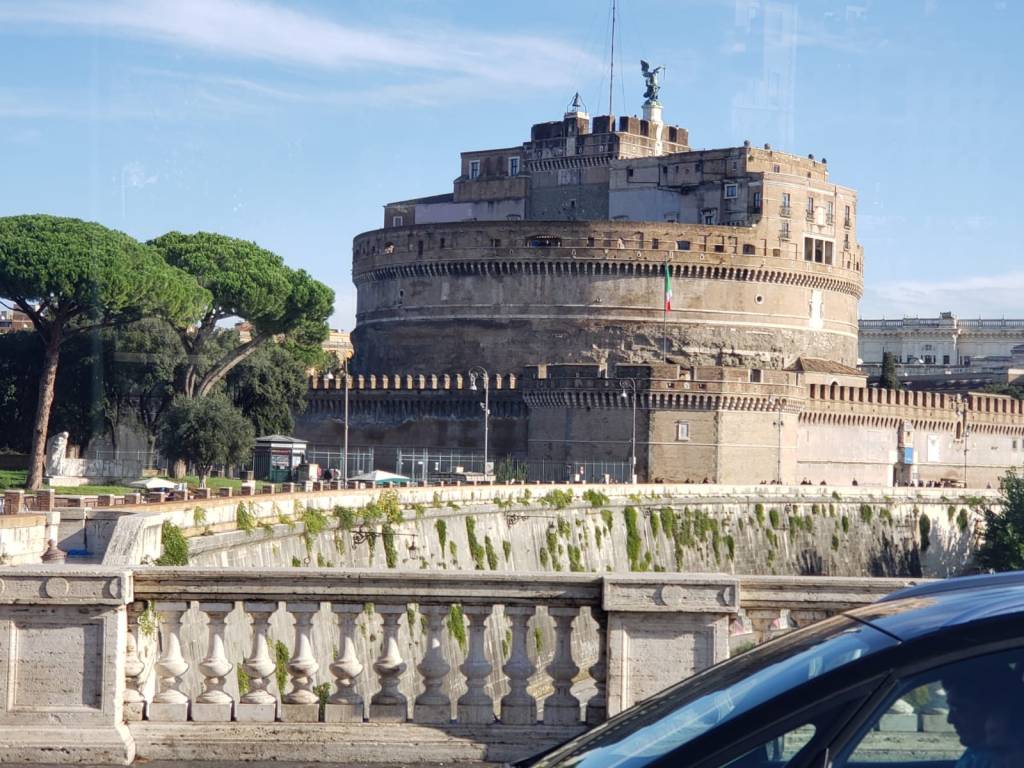
Tiber River and St. Peter’s Basilica outside of Castel Sant’Angelo

I’m back from my week long adventure in Rome!! Now I’m going to share my experience and some general costs.

TL:DR Flights were long. We didn’t get robbed. Their public transportation is difficult expect getting lost to be part of the adventure. Food is delicious if you like pizza and bread. Gelato is very yummy. There is a lot of awesome history in Rome. Pompeii was also very historical. Basically, Rome is like NYC only older.

First off, the flights there and back were exhausting. We rode three planes each way, and had to drive three hours to the Oklahoma City airport. The final drive home from Oklahoma City after we’d already been traveling for 24 hours was brutal. But our round trip ticket was only $627 each. Which is a steal. Most flights with only one stop out of Dallas are at least $1200 (round trip non stop out of Dallas is not available). And now that I’m on the other side of that traveling misery, ehhh it was worth it.

Second. We didn’t get robbed. Even though everyone we ever told that we were going to Rome HAD to warn us of the dangers of pick pocketing, we managed to visit the Eternal City without possessions being stolen. One lady even told us “Everyone gets robbed” on one of our plane rides. Well lady WE DIDN’T so take that! While we were a little irritated at all of warnings about pick pocketing, we didn’t ignore them. Richard kept his money in his front pockets. Because he’s a man and he has pockets. And I carried a backpack. This backpack has three pockets. In the front pocket, I stuffed a sandwich. Which I was actually hoping somebody might try to steal because that would have been funny. My debit card and passport were kept in the middle pocket and since it was raining off and on most of the time we were there; I wore a jacket over my backpack so that no one would be able to slip a hand in. So that’s the first step. Don’t make it easy for them. Second step, be aware. The only person that we came across that we thought might have been trying to steal from us was on the train to the city from the airport. This lady, looking like a meth head gets on the train with her bike. She’s acting erratic. Running between both of her bags muttering Italian under her breathe and bad English. Richard and I were in each corner. With our bags tightly gripped. She hands Richard a cigarette, which he sets down. Then she leans her bike on me. Which I promptly move and let fall. Then she starts asking for our phones to call her husband. I quickly said “We don’t have service here.” Which was a lie but I didn’t care. When we got to the next stop, a non-looking meth head twenty-something man comes down from the top section and they start muttering, SHE PULLS OUT A PHONE and they get off the subway together. Really lady. Not cool. We’ve only had half-assed plane sleep for the last 24 hours and you’re going to try to rob us right when we get here?! But after that we had no issues.

Public transportation. Public transportation in Rome consists mostly of buses. There were a couple subways but we never used them. Their system is not well catered to tourists. I never found an offline route map for each bus route probably because they change depending on the time of day. Even though the routes at every stop are listed; the names of the stops and the streets they are on is pretty useless information if you don’t know the city that well. So we struggled with that. On one particularly embarrassing occasion we got onto Route 46 on the wrong side of the road which proceeded to take us two hours out of the way to the far northeast side of the city. That was a frustrating morning. But after that mishap, we started to get the hang of it. Unlike what the internet says, bus tickets are not available at every stop. We bought our 48 hour pass at a small store near the Vatican for 12.5 Euro. But upon riding on the buses we realized something. Most people do not run their ticket or proof of legal riding the busses everytime they get on. So we just didn’t either. When in Rome right? But if you don’t scan your ticket and the police do a surprise inspection and your ticket has not been stamped, you could be fined. We got stopped by the police at Termini, the main station but we had our tickets on us so the police lady just assumed we were dumb tourists and showed us how to scan it and then let us go. Another tourist that didn’t even buy a ticket for the bus, received a fine from the police. We heard her claiming that she couldn’t buy a ticket because the bus driver wouldn’t stop for her. Which made no sense but her English was broken sooo idk maybe something else happened. Anyways, we escaped that issue. We rode the trentralia train to Naples and it was really nice. An extremely smooth ride, it had comfy seats with tables, wifi and a gorgeous view of the Italian countryside but it was expensive. At about $200 round-trip for both of us, we paid for that luxury. We also took a train from Naples to Pompeii. It was difficult to find and we spent awhile wondering around Naples until we found it. It was cramped, smelly, slow, and covered in graffiti. But it was only $12 for both of us round trip.

Food. Italians love sandwiches, pizza, croissants, and espresso. I’m not sure there was really much else to eat. My favorite sandwich was a flat one with spicy salami that we actually bought in Castel Sant’Angelo. And my favorite pizza was a mozzarella and salmon pizza that we got at a restaurant near where we were staying off of Gregorio VII. Yeah, I know, weird, but it was really good. We spent about $550 on food for the two days of traveling and 5 and a half days we stayed in Rome. And that includes the small amount of groceries we bought for snacks and breakfast every morning. (Italian breakfast of a croissant and an espresso was not enough to sustain the amount of walking we were doing everyday.) So we actually went about $150 over budget but that’s still not bad and we splurged a couple of nights and had a steady stream of wine so I think we did good. We did get nervous however when a man on one of our flights told us that he and his wife had a small pizza, and two teas for 60 euro. However, we never saw prices like that and luckily most restaurants post their menu prices right outside of the door. My only advice is to ignore the middle eastern man trying to coax you inside and only eat there if you want to. Also, gelato is the best thing ever, I was pretty obsessed with it.

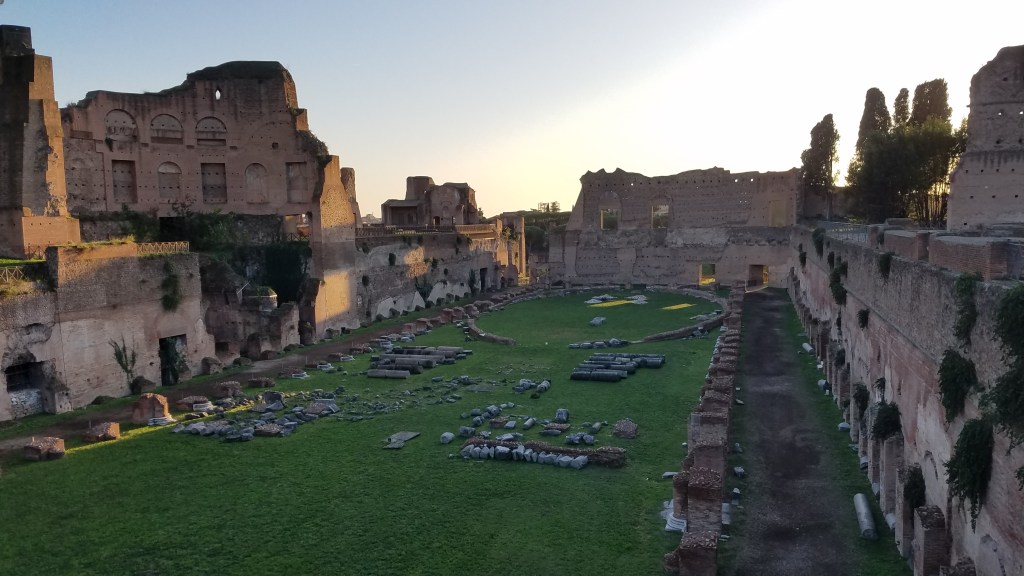
And now on to what we saw. The first day we saw the Colosseum, the Roman Forum and the Palatine Hill. The Colosseum was amazing and huge and a great piece of history but neither Richard nor I were as impressed with it as the Roman Forum and the Palatine Hill. The Roman Forum consists of the ruins of the financial and business district of the Roman Empire dating back to Caesars’ and Emperor Augustus’ time. Basically the Wall Street of the Roman world. And the Palatine Hill holds the ruins of Emperor Augustus’ House, a large stadium and the ruins of the beginning to civilization in the area dating back to 900BC. Not to mention breathtaking views of the city and relaxing walks. These two areas were more of an afterthought and yet, they were filled with amazing ruins and history.

The roman forum
Stadium on Palatine Hill
The Colosseum

The second day we went to the Vatican. We stood in line at St. Peter’s Basilica and only waited for about 20 minutes. But we got lucky because right after we got in line, it started stretching around the Piazza even in the rain. I’m not catholic but I took a moment standing in the most beautiful building I have ever been in to stare at the walls and the sculptures. And I mean to really look at everything. Not take a picture and walk away. To really take in where I was and what it meant to millions of people around the world and throughout history. I tried to take in how beautiful it was and appreciate the time it had taken to build it and I actually started to cry. I got emotional and had to wipe my face off, hoping the guard wouldn’t notice. It was truly breathtaking. I think I will always get a little emotional in remembrance of that place. After the Basilica, we went to the Vatican Museums. Which also held beautiful statues, paintings all over the walls and ceilings, rugs, maps and old globes. We didn’t get to see everything but we did get to see the Sistine Chapel. And to be honest, we were both a little disappointed. Yes it was beautiful. But it was so packed and we were all sort of tunneled in there with the words “no photo, no video’ being repeated constantly that it was difficult to properly enjoy it. Then we walked to the Castel Sant’Angelo. This was one of my favorite places in all of Rome. With a rich history, from Emperor Hadrian’s tomb (he really built a lot while he was emperor), a fortress with a corridor for a retreating pope in danger from the Vatican, to a prison and castle for Popes. The museum is sort of set up like an Ikea store; you move through the walls on a path going up and up past the ashes of Emperor Hadrian, and the courtyard where prisoners were hanged all the way to the top. The views are beyond amazing. Including a skyline of the Tiber River and the Basilica in the distance. And as it started to rain while we moved through the Castel, Richard and I really felt and pretended like we were in the midst of a muddy defense in the middle ages.

St Peter’s Basilica
The Pope’s Alter
Castel Sant’Angelo

The third day, we actually went back to the Roman Forum and the Palatine Hill and then finished the day with the Trevi Fountain. The fountain is absolutely gorgeous. It was crowded but we were still able to get to the front and snap a few photos while I read off a few facts about the beautiful location and then we left. Fun fact, this super famous fountain was actually built in 1762, which by roman standards, is a pretty new addition.

Trevi Fountain

The fourth day we decided to take a bold day trip to see the Pompeii ruins. I’ve always been fascinated with Pompeii’s history and had a distinct connection with the fear of an erupting volcano since watching Dante’s Peak at to young of an age so it felt like it would be worth the 3 our trip each way. We had to take two buses, and two trains to get there. Albeit getting lost a couple times, we did eventually make it. It was a beautiful day and the ruins are absolutely gorgeous. Dozens of houses in amazing condition are preserved throughout the streets, some with gardens in the center and bones in corners makes the location eerily both romantic and haunting. We saw only a few of the casts and I was a little disappointed about that so if you go there make sure you make time for the museums that house the casts but the few I did see were absolutely heart wrenching. A child and mother frozen in time, you could almost see the emotion in their face frozen in the ash. The fear and realization that they were going to die transcending thousands of years through a cast is a really odd connection to have with another human being.

Cast of a child from the eruption in Pompeii
Bones in one of the houses at Pompeii
Garden in Pompeii

The fifth day, our last day in Rome, we slept in a little and then visited the Pantheon. An old pagan building transformed into a church/mausoleum that was extremely stunning. The dome was so large and ornate that it barely looked real and the grave of Rafael, the famous artist buried among kings was also beautiful. When we left the Pantheon, it began to rain but we had only one remaining goal, to see the Spanish Steps. However, the rain poured and we got soaked and lost and confused on a few of the streets. So by the time we made it to the Spanish Steps, I was cold and wet and I literally took a picture and then wanted to leave. But we made it!! We saw everything we wanted to see!!

The Pantheon

Total, including airfare, airbnb, food, and transportation, we both spent a little over $2770. We went over budget by $400 but the original budget didn’t include Pompeii so I think we did really well. I really enjoyed going to Rome with my boyfriend and now I’m going to start planning our next trip to Tokyo, Japan!

Not quite bilingual…

I have made it a personal goal to become fluent in Spanish. If you have interest in learning another language, I definitely recommend getting the Duolingo app. But you must do it everyday and you have to practice what you learn through the app on your own. I think it helps a lot. Not only am I using it for Spanish but I’m also using it to learn some Italian before our trip tomorrow.

But I find it very difficult to be bold enough to speak the language in conversation. I get plenty of customers that speak Spanish that I could practice on. But they look at me, see that I’m white and the bilingual kids translate what the parents are saying, even though I can understand them. And I just freeze. I don’t know how to say speak Spanish to me so I can practice but speak slowly because I’m not really that great yet without coming off rude when they aren’t even looking at me. And I’m also nervous that surprising them with Spanish will cause a similar look that I get when people find out that I, a female, majored in engineering. The looks of disbelief can be patronizing and the conversations confirming what I just said can be repetitive and boring. And I don’t want to have the conversation, yes I’m trying to learn Spanish, No I’m not Hispanic, a million times. I just like the language and think it would be intrinsically and extrinsically useful. So instead, I just stare and sort of act like I don’t know that he just said he wants coffee and water.

Yesterday, I was at Walmart looking at something and an elderly Hispanic man comes up to me and asks if I can speak Spanish because he needs help translating to the employee. I know that’s what he said. But I panicked and said I only knew a little Spanish. Which of course caused him to stare at me puzzled since I’d clearly just understood what he said. The employee walked over and was all ‘it’s okay don’t worry’ shooing me away, further destroying my confidence. The man continued to speak Spanish to me describing the type of shoes that he wanted but there was one main word I didn’t know, and I froze further. Excited that I mostly understood but frustrated that I couldn’t prove it. I fumbled awkwardly for my phone like it might help. I felt like I was being interviewed for a job and asked the dreaded “so tell me about yourself.” And all knowledge of myself had immediately flown out of my brain. Every Spanish word that I knew melted into a slush pile of ‘haw-blow por-key-toe es-pan-nole.’

While the Asian employee continued to attempt to shoo me away in her own broken English, a young Hispanic boy walked over. The employee asked if he spoke Spanish and he said he could and agreed to help translate. So I ran away.

Obviously, it’s probably something I’m just going to have to get over if I actually want to become fluent. I’m just going to have to push myself past the discomfort and awkward frustrating conversations.

The Joker and Mental Health

I finally watched the new Joker movie this week so spoiler alert if you still haven’t seen it.

I believe it is an iconic movie for multiple reasons but I saw a meme that said “someday someone will break you so badly that you will become unbreakable” with the joker smoking a cigarette behind the words. This by itself is a great sentiment. About resolve for yourself and taking hurt and turning it into your strength. But this in no way should be associated with The Joker. Ask yourself if you want someone who is mentally ill and wants to kill people to turn their hurt into strength. These type of phrases and glamorization of mental illness perverse the movie and it’s message.

Yes, this is an origin story for a made-up villain in a made-up world that clashes with a made up hero but what is this movie actually about? Its main message came out of The Joker’s mouth himself. THIS IS WHAT HAPPENS WHEN YOU ABANDON THE MENTALLY ILL. They cut funding taking away his medicine and assigned him counselors that were tired, overworked and unconcerned. The only way he got attention was being made fun of. Was getting beaten up and blamed for it. Was to be given the same requirements in an operating society that was on normal adults. And as a result of this expectation he is defensive and can’t explain himself like a rational adult. He writes in his notebook “people expect you to behave as if you don’t.” He can hand them a card apologizing to them that he’s laughing, (as if he owes them an apology) and they will disregard it and continue to treat him cruelly. We can read about symptoms of a disorder and understand them but when confronted with them directly, we still struggle to not put the blame on the person with the disorder.

I know that you have depression but why do you have to be so sad all of the time? Life could be a lot worse.

I know that you have Alzheimer’s disease, but please just remember to do this one little thing.

I know you have bipolar disorder but why can’t you just make good decisions?

I know you have post traumatic stress disorder but please try not to wake me with a nightmare tonight. Just think happy thoughts so you feel better.

But instead, we see Joker’s rise to power as a symbol of strength. That he is now unbreakable. But the result of his rise to power isn’t because he grew stronger. His mental health deteriorated because of lack of support, understanding and compassion by people that repeatedly attempted to sweep him under the rug. And the only reason he rose to a position of leadership was because a lot of people felt abandoned.

This isn’t a glorification of mental illness. This is a message about compassion and what happens when it leaves society.

But on the bright side at least they saved a couple thousand dollars cutting that funding.

Amber, Botham and Murder in our Country

Since I watched a lot of the trial and I’ve thought a lot about it the last few days, I want to discuss the Amber Guyger case. The hard to swallow pill is that opinions on anything with which you weren’t directly involved are likely to be highly ill-informed. Before you make a large assumptive statement based on click bait titles from news stations that didn’t even get a seat in the courtroom, think about the validity and importance of your opinion. Guess what, you have none. I have none. The only two people that have the real understanding of what happened are Botham Jean and Amber Guyger. Unfortunately, only one of them is still alive and that leaves the rest of the ill-informed world to judge her based on ‘facts’ that can usually persuade you with ethos and pathos on your position.

But, judging her is required. It’s required so that she doesn’t do it again. It’s required so that we learn from both of their mistakes. It’s required so that apartment complexes fix locks quickly. And it’s required to send a message to everyone that no matter who you are, you will be held accountable for your mistakes and actions. And because of that, I’m not going to talk about my opinion of her trial and the case, instead, I’m going to talk about murder.

When we think about murder cases; we think of them as distant. Things that can never happen to us. And for the most part, you’re right. We individually have a 1 in 20,000 chance of being murdered. If you played women’s basketball in high school, you actually have a better chance of becoming a professional basketball player (1 in 13,000) than you do of being murdered. And you have a better chance of dying of leukemia than you do of being murdered (1 in 12,500). But being murdered yourself isn’t the only way that murder can affect you.

The odds get closer when you look at the chances of your immediate family getting taken from you. That being your Mom, your Dad, your brother or sister (assuming you only have two siblings) and one of your two children (if you have any) has a 1 in 3500 chance of having their life taken from them from another human being. To put that into perspective, average cruise ships hold about 6,000 people and Jesus was able to feed 4,000 people with a few loafs of bread and a couple small fish, granted it was a miracle. But anyone who watched the case for the trial this past week knows that it isn’t just immediate family that is affected by a murder. If we use Dunbar’s number of about 150 people, which includes immediate family, extended family, close friends and friends you see regularly, coworkers and a couple acquaintances, then the chance of you knowing someone in at least a familiar social way that will be murdered goes up to a 1 in 140 chance. That chance isn’t far away at all. We see all kinds of stories of murder on television but we push them far away so that we don’t have to deal with them. So that we don’t have to deal with as much fear as we should be feeling.

We don’t think about every day actions that we do that could increase our likelihood of being killed randomly or personally by another human being. Did you know that driving with your doors unlocked or going to the ATM at night can increase your chance? Did you know that you are most likely to be killed by someone in the same demographics as you? Even in a diverse nation, we are most likely to be killed by people in our own race and age group. Unless, of course, you’re a woman and then you’re most likely to be killed by your husband or your boyfriend. That means that the single most important decision a woman can make in preventing herself from being killed is the partner that she chooses.

What happened to Botham is so tragically seared into our minds because we realize that that could happen to anyone. Anyone could be sitting on their couch, watching television and then get shot dead by an intruder into their home. And there is no way that he could have prevented it. We dismiss most murders because we think, oh I’m not a prostitute or a druggie or a black man or a woman who chose the wrong husband. I would never make THAT mistake or that’s a problem for that demographic to deal with, not me. So why worry? What can we even do about it? I don’t have the answers and I don’t have any solutions. I think that it’s just something we should be conscious of and be educated on. Educate others. Protect yourself and the ones you love because losing each other before our time is way more prevalent than you might imagine.

And if you must state an opinion on the Amber Guyger Case, please at least watch the trial first.

https://www.statista.com/statistics/195331/number-of-murders-in-the-us-by-state/
https://www.worldometers.info/world-population/us-population/
https://www.google.com/search?q=population+of+texas&rlz=1C1NHXL_enUS847US847&oq=population+of+texas&aqs=chrome..69i57j0l5.3591j0j8&sourceid=chrome&ie=UTF-8

https://www.dartmouth.edu/~ears5/handouts/Prob_dying6_25_99.html

https://en.wikipedia.org/wiki/Dunbar%27s_number

Rome Trip Nov 2019

Here is a tentative plan and cost of the trip Richard and I will be taking to Rome in November. If you’re curious about what we will be spending or if you’ve ever thought about going yourself but was overwhelmed by the costs, my estimated costs are below so that you can begin to think about whether you could afford a similar trip.

All of the costs except the Plane ticket and airbnb are approximate and taken from different travel sights and the Eyewitness Travel: Rome book that I got for trip as a reference. ($10 at half price bookstore)

The total cost for both of us is estimated at about $2,382.50 or $1,191.25 individually.

Individual ($)Both ($)Notes
Plane Ticket627.031254.06
Airbnb163.72327.44
Tourist Fee2550
Parking2484to leave car at okc airport
Gas2040to and from okc airport
Eating tues 5th2040travel day
Train from Airport to Rome6.513
Roma Pass 72 Hrs4386either this and 3 days or
BIT 3 Days12.525public transp.
BIT 7 Days1836this
Vatican and sistene Chapel1938
Roman Forum/Colessium13.527
Wed 6th food1530half day
Thurs 7th food2648save money if grocery shop
Fri 8th food2648
Sat 9th food4080one night of splurging
Sun 10th food2648
Mon 11th food2648
from rome termini to airport2040arrive at airport at 5:48
eating tues 12th2040travel day
TOTAL1191.252382.5
Food Total199398
Cost after flight and room400.5801
A few places to eat at:
Pizza Zizza https://www.tripadvisor.com/Restaurant_Review-g187791-d7983637-Reviews-Pizza_Zizza_Caffetteria_Birreria_Desserteria-Rome_Lazio.html
Barnum Cafe https://www.tripadvisor.com/Restaurant_Review-g187791-d3626857-Reviews-Barnum_Cafe-Rome_Lazio.html
Pane e Salame https://www.tripadvisor.com/Restaurant_Review-g187791-d10044289-Reviews-Pane_e_Salame-Rome_Lazio.html
Tentative Plan:
Wed 6thDepends on what we want to do when we land
Thurs 7thRoman Forum, Colosseum
Fri 8thThe vatican, St Peters Basilica
Sat 9thPantheon, Trevi Fountain, Spanish Steps, shopping
Sun 10thOther churches and museums we’d like to see
Mon 11thFree day (museums and churches mostly closed on mon)

Three Types of Conversations

I’ve tried to do some research on this but definitive answers are difficult to find so I’m extending the discussion through my blog. Disclaimer, this is a bit of a taboo topic and I could definitely be wrong here. I’m not writing this blog to attack anyone specific; it is merely designed to open a discussion or to get you to think about the ways in which you converse with the people you care about. I see a lot of memes and comments on social media that encourage people to reach out to one another. But unfortunately, what that equates to is the first type of conversation:

Friend 1: Hey, How are you?

Friend 2: good

Friend 1: that’s good

END OF CONVERSATION

 Now, if you are Friend 1, you might be asking yourself what did they do wrong? I don’t know if I would call it wrong as much as I would call it a waste of time. I understand that Friend 1 is ‘checking up on’ Friend 2 out of concern. I am not criticizing the effort. But in some ways, I think this conversation can make people dealing with something traumatic or a mental disease to feel more alienated because the conversation is shallow and lacks a connection.

If you’ve ever been on Tinder or another dating site, you might ask yourself why 99 out of 100 conversations that you start or receive sputter and die. That’s because neither one of you are saying anything. Neither one of you is challenging. Neither one of you is curious. Neither one of you is interesting. Here is another example of a conversation that lacks substance.

Person 1: Hey ur hot

Person 2: thanks

Person 1: wyd

Person 2: texting you

Person 1: I feel lucky 😊

Person 2: you should

Person 1: what are you doing tonight

Person 2: working

Person 1: oh

AND THEN THE CONVERSATION DIES. One of you goes onto the next lame conversation and the other posts on facebook about how they can’t find love. Hard to swallow pill: You are both acting boring and wasting each others’ time.

Conversation Type 2:

Person 1: Hey how are you doing

Person 2: good

Person 1: that’s good what are you up to?

Person 2: Listening to the new song by Luke Combs

Person 1: Oh do you like Luke Combs? I love his music.

Person 2: Yes I do. I saw him live awhile time ago.

Person 1: he’s doing a show in Dallas next weekend, I was thinking about going.

This conversation is better because there is at least common ground being formed. Person 2 risks revealing something about themselves not knowing whether they will be ridiculed for liking something on the off chance that they might share that interest and the result is a formed connection. In fact, a connection can form whether they share it or not because now they can discuss why they don’t like something. But this connection paves the way for something further down the line. However, there is an inevitable problem with these types of connections though. The truth is that after the third time talking about different tastes in music, the conversation can get stale. There are only so many times you can talk about your likes/dislikes, habits or your pasts’. Anything that doesn’t change as the sole source of a relationship’s dialogue can’t last. Unless of course, you’re ok with not talking to your husband for years at a time until one of their likes changes and you have something to talk about.

So for the third type of conversation:

Person 1: Hey How are you doing?

Person 2: good

Person 1: what are you doing

Person 2: I was just thinking it would be funny if we had grab bags of prescription pills like we used to get at the dollar tree for toys.

Person 1: Wait. What. How did you think of that?

Person 2: Well I’m in line at CVS and I saw a small paper bag with lettering on it and my first thought was ‘oh those grab bags I used to get when I was a kid’ Of course, then I realized where I was and that those definitely weren’t bags of toys. And I thought what if they just handed me a bag of random prescriptions once a month.

Person 1: OH LOOK! I got Viagra and an antidepressant but no allergy medicine in my bag! Going to be an interesting month…

This type of conversation is the most beneficial because one person is challenging and the other is engaging. It forms a real connection that can be repeated in the small moments of everyday. And that is what we all crave.

If you feel like you can’t connect with people, if you feel lonely, it’s because you aren’t sharing enough of yourself. Your true self. The self that is always changing and always discovering. Whether it’s negative or positive, search for it, accept it and share it.